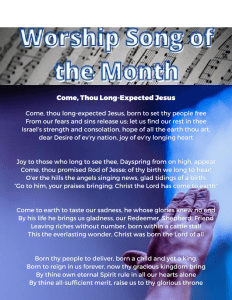
The second and third verses of Come, Thou Long-Expected Jesus, written by Mark E. Hunt and inserted between Charles Wesley’s verses, summarize the story of Jesus’s birth and proclaim the reason for his birth. On this Christmas Eve day, it is appropriate for us to sing these words, and to recognize who Jesus is and why he came.
Jesus is the promised Dayspring from on high. Using the King James Version of the Bible, Hunt references Zechariah’s prophetic declaration that “the Dayspring from on high has visited us; to give light to those who sit in darkness and the shadow of death, to guide our feet into the way of peace” (Luke 1:78-79). I love this idea of Jesus as the dawn, the sunrise. When we come to know Jesus, our hearts and minds are enlightened with the knowledge and understanding of salvation (Luke 1:77), and our lives emerge from darkness into forgiveness and mercy (v. 77-78). And as we come to know him more and more, his light grows and spreads on our paths, lighting the way (vs. 79).
Jesus is the promised Rod of Jesse. We know that Jesus is the fulfillment of a great many Old Testament prophecies, including those which spoke of his lineage. Jesus descended from King David, who was the son of Jesse. Isaiah 11:1 declares: “There shall come forth a Rod from the stem of Jesse, and a Branch shall grow out of his roots.” When we proclaim that Jesus is the Rod of Jesse and the Son of David, we declare that Jesus is the Messiah who was promised to the Israelites–a Messiah who would be their Savior, King, and Priest forever (Jeremiah 33:15-18). But we also recognize that these promises are not only for Israel, but for all who believe in Jesus. As Isaiah 11 continues in verse 10: “And in that day there shall be a Root of Jesse, who shall stand as a banner to the people; for the Gentiles shall seek him.”
Which brings us to this: Jesus is the promised Redeemer. He came to earth to “taste our sadness” and “bring us gladness.” He came to rescue us from the darkness of sin and death. He came to die on the cross. Galatians 3:13-14 says, “Christ has redeemed us from the curse of the law, having become a curse for us (for it is written, ‘Cursed is everyone who hangs on a tree’), that the blessing of Abraham might come upon the Gentiles in Christ Jesus, that we might receive the promise of the Spirit through faith.” Jesus, whom the prophets called Dayspring, Rod of Jesse, and Redeemer, came to save not only the Israelites, but all of God’s people who come to him by faith.
“This the everlasting wonder: Christ was born the Lord of all!”
For Reflection: Read Isaiah 9:2-7. What does this passage say about Jesus’s roles reflected in the titles Dayspring, Rod of Jesse, and Redeemer? Praise Jesus for who he is, and thank him for coming to bring you light, include you in his people, and save you.
The first verse of Come, Thou Long-Expected Jesus is both very broad and extremely personal. The verse resounds with national ramifications—“Born to set thy people free!,” and with personal repercussions—“From our fears and sins release us; let us find our rest in thee.” It expresses far-reaching consequences—“Israel’s strength and consolation, hope of all the earth thou art; dear Desire of ev’ry nation,” and intimate hope—“Joy of ev’ry longing heart.”
One of the most dramatic prophecies about the birth of Jesus is in Haggai 2:6-9, from which Charles Wesley’s phrase Desire of Nations comes:
“This is what the Lord Almighty says: ‘In a little while I will once more shake the heavens and the earth, the sea and the dry land. I will shake all nations, and what is desired by all nations will come, and I will fill this house with glory,’ says the Lord Almighty. ‘The silver is mine and the gold is mine,’ declares the Lord Almighty. ‘The glory of this present house will be greater than the glory of the former house,’ says the Lord Almighty. ‘And in this place I will grant peace,’ declares the Lord Almighty.”
When I think of God shaking the heavens and the nations, my first thought is not of a little baby. When I hear that God will fill his house with glory, I don’t picture a stable in tiny Bethlehem. When I think of the great riches God has, I may wonder why he would leave all of that behind. And my expectations of peace may be a conquering Messiah, not a Messiah on a cross.
Perhaps one of the most amazing things about the incarnation is this juxtaposition of Great and Small. The King of the universe humbled himself and became a vulnerable baby. The One who owns “the cattle on a thousand hills” slept in a manger. He who spoke life into existence came to die. God himself became man. And, as we sing in “Come, Thou Long-Expected Jesus,” Jesus’s birth is a game-changer for Israel, all the nations of the world—and for me.
Jesus is both the Desire of Nations, and the Joy of my Longing Heart.
For Reflection: Read John 1:1-14 and 3:16-21. What do these passages say about Jesus’s divine nature? How did Jesus humble himself? What does this say about God’s love for us? Reflect on Jesus as the joy of your longing heart.
Come, Thou Long-Expected Jesus is a wonderfully theological Advent hymn, referencing Scripture after Scripture to point to the promised Messiah. When we sing it, we are joining with the prophets in saying: Come, Desire of Nations! Come, Rod of Jesse! Come, Redeemer and Dayspring! Come, promised King!
Of course, these prophecies were written in the hope that a Messiah would be born, but we have the privilege of knowing that he was. So, in the very first line of this hymn, we profess Jesus as the fulfillment of the prophecies: Come, thou long-expected Jesus!
At the church at which I serve, we are singing one verse of “Come, Thou Long-Expected Jesus” each week throughout Advent, after we light a candle on our Advent wreath. By the time Christmas Eve rolls around, we will have sung four verses of this beautiful hymn.
Four verses, you ask; aren’t there only two?
It is true that Charles Wesley only wrote two verses of “Come, Thou Long-Expected Jesus.” The text was one of eighteen Christmas songs written by Wesley and published in Hymns for the Nativity of Our Lord in 1744. But in more recent years, Mark E. Hunt wrote two additional verses to be inserted between Wesley’s verses. The new 4-verse version was published by Intervarsity Press in 1978 and recorded in the Trinity Hymnal in 1990.
I personally love the new verses and how they contribute to the original. I appreciate how the new verses create a flow from thought to thought, with each verse starting where the previous verse left off, as if we were singing one long run-on sentence:
Come, thou long expected Jesus, joy of ev’ry longing heart…
joy to those who long to see thee, Christ the Lord has come to earth…
come to earth to taste our sadness, Christ was born the Lord of all…
born thy people to deliver, raise us to thy glorious throne!
The four verses seamlessly lead us from the expectation of Jesus’ birth (verse 1) to the story of the birth (verse 2) to the reason for his birth (verse 3) to the expectation of Jesus’ return (verse 4).
I hope that as we sing this song in anticipation of Christmas, we will remember how God kept his promise to send the Messiah. And I hope that we will look forward, with renewed passion, to his promised return.
For Reflection: Haggai 2:7 was a main inspiration for Wesley’s lyrics. Read Haggai 2:6-9 and think about how Jesus fulfilled Haggai’s prophecy in this birth and death, and how he will fulfill it at his second coming. Sing “Come, Thou Long-Expected Jesus,” praying for Jesus to come again soon.
This past Sunday, we entered the season of Advent in the Christian calendar. During Advent, we remember the years of waiting that God’s people experienced — a season of silence between the prophecies and the Prophesied. And we celebrate the end of that silence — when the prophecies were fulfilled in Jesus. The culmination of the Advent season is Christmas (or Christmas Eve), when we rejoice in the “advent” or “coming” of the promised Messiah.
The third verse of By Faith leads us nicely into the Advent season. “By faith the prophets saw a day when the longed-for Messiah would appear, with the pow’r to break the chains of sin and death, and rise triumphant from the grave.” These lyrics remind me of the prophecy which Isaiah gave (Isaiah 61:1-2a) and Jesus explicitly claimed to fulfill (Luke 4:14-20):
“The Spirit of the Sovereign Lord is on me, because the Lord has anointed me to proclaim good news to the poor. He has sent me to bind up the brokenhearted, to proclaim freedom for the captives and release from darkness for the prisoners, to proclaim the year of the Lord’s favor.”
The lyrics also remind me of Zechariah’s song of praise inspired by the Holy Spirit in Luke 1:67-79:
“Praise be to the Lord, the God of Israel, because he has come to his people and redeemed them. He has raised up a horn of salvation for us in the house of his servant David (as he said through his holy prophets of long ago), salvation from our enemies…
“Salvation through the forgiveness of their sins, because of the tender mercy of our God, by which the rising sun will come to us from heaven to shine on those living in darkness and in the shadow of death, to guide our feet into the path of peace.”
We see in Zechariah’s prayer that the Advent of Jesus means not only release from physical slavery but salvation from our chief oppressors, sin and death. This victory over sin and death is because of the death and resurrection of Jesus Christ (1 Corinthians 15:54-57) — whose birth we celebrate in this season.
As a worship leader (and worshipper), one of my favorite things about celebrating Advent in church is hearing the many, many prophecies in Scripture read out loud, and singing songs that relate these Old Testament prophecies to the birth of Christ. As we listen and sing, may we be reminded of all of the wonderful prophecies that Jesus fulfills, and worship him.
For Reflection: Read Isaiah 61. Think about sins in your life, and ask God to forgive your sins in his tender mercy. Think also about suffering you may be enduring, and the pain or death of loved ones. Thank Jesus for coming to earth to bring freedom for the captives and release from darkness for the prisoners. Thank him for promising victory over sin and death and an inheritance of joy, salvation, and righteousness. Ask him to help you to live by faith in these promises.
On a Sunday night during the week of Thanksgiving, our church family gathered together for an informal worship service — a time of eating, singing, praying, and sharing our reasons for giving thanks. Because of the current covid-19 pandemic, we made safety a priority — catering the food, spacing and individually releasing the tables, singing only briefly, and wearing masks. Despite all that, we had a wonderful experience of celebrating God’s goodness to us. We also had fun doing a “Readers’ Theater” of Five Thanksgiving Scenes from the Bible. This was my first time writing such a script, and our church people were the best readers a brand-new playwright could ask for! We chose a reader from each table, gave them each highlighted parts, and they read clearly and enthusiastically from their spaced tables.
I’m sharing this little script in the hopes that others can use these Scenes in their church, family, or small group worship. (Please just remember to give credit to the author in any written publications.)
Without further ado, I give you — FIVE THANKSGIVING SCENES.
Narrator: Scene 1. The news has just arrived that a great big army is coming after God’s people. The king of God’s people is a man with a funny name, Jehoshaphat, and he’s scared. So, he calls all of the people together to pray for God’s help.
Reader One (male): “Lord, you rule over everything! Power and might are in your hand! We remember how you got rid of our enemies before. So now, won’t you take care of these invaders? We don’t know what to do, but our eyes are on you.”
Narrator: Then the Holy Spirit comes on another funny-named guy, Jahaziel, and he stands up!
Reader Two (male): “Listen, everybody! The Lord says, ‘Don’t be afraid. Tomorrow, go out to face your enemies, and I will be with you.’”
Narrator: Jehoshaphat believes Jahaziel, and before the battle even starts, Jehoshaphat assigns people the job of singing a song of thanksgiving:
Readers One and Two (together): “Give thanks to the LORD! His love endures forever!”
Narrator: While they sing, God ambushes the enemies with… other enemies! The new enemies fight the original enemies. Then, after the original enemies are defeated, the new enemies turn on each other. When God’s people come to the place where the battle was going to be, all of the enemies are already dead.
Reader One: When we face tough fights in our lives, let’s remember to give thanks even before the battle begins. We can trust God with the result, saying, “Give thanks to the LORD! His love endures forever!”
Narrator: Scene 2. Hannah is a young lady who loves God. But she is very sad, because she isn’t able to have any children. She’s so sad, that she won’t stop crying, and she won’t eat. Weeping uncontrollably, Hannah goes to the temple to pray.
Reader Three (female): “Lord, I’m your servant. Don’t forget me; please give me a son. If you do give me a son, I will dedicate him to serve you at the temple.”
Narrator: While Hannah is praying, her lips are moving even though she isn’t praying out loud. So Eli, the priest, thinks she’s drunk.
Reader Four (male): “Lady, don’t drink anymore!”
Reader Three: “I’m not drunk, I’m just really, really sad. And I’m pouring out my soul to the Lord.”
Reader Four: “Go in peace. May God give you what you’ve asked.”
Narrator: Hannah is no longer sad. God answers her prayer, and she gives birth to a baby boy. She names her son Samuel, which means “God heard me.” Hannah also keeps her promise to God, and Samuel grows up at the temple, loving God and listening to his voice. Eventually, Samuel becomes a prophet who shares God’s messages.
Reader Three: When we are sad, we should go to God and pray. And when God answers our prayers, let’s remember to give him credit. We can say to God, “You heard me.”
Narrator: Scene 3. A girl stands, stunned, looking at the angel who just told her she is going to give birth to the Son of God.
Reader Five (female): “How will this happen?”
Reader Six (male): “Mary, the Holy Spirit will come on you, and your son will be the holy Son of God. No word from God will ever fail.”
Reader Five: “I serve the Lord. I accept God’s word to me.”
Narrator: Mary is very young, and unmarried, and will suffer both shame (initially) and sorrow (eventually) from her role as mother to Jesus. But even though her situation isn’t easy, she gives thanks to God. She even makes up a song to express her thanks.
Reader Five: “My soul magnifies the Lord! I have joy in God my Savior. He has remembered me and blessed me. Holy is his name!”
Narrator: Later, Mary gives birth to Jesus, the Son of God. She remembers all of the amazing things that have happened, and spends time thinking about them.
Reader Five: When God gives us blessings we don’t expect—even situations that seem hard or uncomfortable—we can say, “My soul magnifies the Lord!”
Narrator: Scene 4. Jesus has grown up, and is going around teaching and doing miracles. As he enters a village, ten men with a terrible skin disease come out to see him. Men with diseases like this aren’t allowed to come near other people, since they are “unclean” and contagious. So, they call out to Jesus from a distance.
Reader Seven (male): “Jesus, take pity on us!”
Reader Eight (male): “Go, show yourselves to the priests.”
Narrator: A long time before this, Moses had instructed God’s people that, if they were cured of a disease like leprosy, they should go to the priests and show them their healed skin. Then, the priests would announce that they were well, and they could go back to being around people again. The men obey Jesus, and, on their way to the priests, they realize they are cured! One of them runs back to Jesus, praising God loudly. He falls down in front of Jesus, and shouts,
Reader Seven: “Thank you, Jesus!”
Reader Eight: “Weren’t there ten men? Weren’t they all healed? Where are the other nine? Rise and go; your faith has made you well.”
Reader Seven: When we experience God’s care for us, let’s remember to say, “Thank you, Jesus!”
Narrator: Scene 5. An old man hunches over a piece of paper. He can’t go outside, because he’s been arrested and right now is either in jail or kept prisoner in a house. His body is in a lot of pain. But despite his suffering, he picks up a pen, and writes a letter to the church in Philippi, saying:
Reader Nine (male): “Rejoice in the Lord! I’ll say it again: Rejoice! Don’t be anxious, but pray to God and give thanks. And God’s peace—more than you can understand—will be with you.”
Narrator: Then this man, whose name is Paul, writes that he knows a secret.
Reader Nine: “I know the secret of giving thanks no matter what. If I’m hungry or I’m well-fed, if I’m poor or I’m rich, Jesus gives me strength.”
Narrator: You see, Jesus had died on the cross and come back to life, and Paul had met the risen Jesus. After that happens, Paul is changed completely, and he starts telling everyone he can about Jesus. Even when he’s in prison and no longer able to travel around telling people about Jesus, he finds a way. He writes letters encouraging and teaching Christians. Paul ends this letter by reminding the church in Philippi—and us—that God will meet all of our needs through Jesus.
Reader Nine: When we are struggling, we should give thanks to God. And when we are thriving, we should give thanks to God. In any situation, “Rejoice in the Lord! I’ll say it again: Rejoice!”
Narrator: On this Thanksgiving, we learn from these Five Scenes, out of many scenes in the Bible where people give thanks to God for his goodness to them. We remember Jehoshaphat, Hannah, Mary, the leper, and Paul. We hear them say:
Reader One: “Give thanks to the LORD! His love endures forever!”
Reader Three: “You heard me.”
Reader Five: “My soul magnifies the Lord!”
Reader Seven: “Thank you, Jesus!”
Reader Nine: “Rejoice in the Lord! I’ll say it again: Rejoice!”
In Genesis 12:7, we read: “The Lord appeared to Abram and said, ‘To your offspring I will give this land.’”
Then, we wait.
In Hebrews 11, the chapter on which the song By Faith is based, we see Abraham (Abram) believing God’s promise. God had told him to leave his country, people, and family, and he “went, even though he did not know where he was going. By faith he made his home in the promised land like a stranger in a foreign country; he lived in tents, as did Isaac and Jacob, who were heirs with him of the same promise. For he was looking forward to the city with foundations, whose architect and builder is God” (Hebrews 11:8-10).
We also see Joseph, a foreigner in Egypt. He has become a prominent leader, and he and his family enjoy health and prosperity. But Joseph longs to return to the land God promised his people.
We see Moses, leading God’s people out of Egypt after they have become enslaved. Moses chooses to align himself with God’s people despite great personal risk, loss, and hardship. But despite God having made the promise to Abraham many years ago, Moses and the people wander for many years in the desert before we see Rahab welcoming the spies into Canaan.
So how did all of these people continue to live by faith, even when they didn’t see God’s promise come to fruition?
Verses 13 through 16 give us the answer:
“They did not receive the things promised; they only saw them and welcomed them from a distance, admitting that they were foreigners and strangers on earth. People who say such things show that they are looking for a country of their own. If they had been thinking of the country they had left, they would have had opportunity to return. Instead, they were longing for a better country—a heavenly one. Therefore God is not ashamed to be called their God, for he has prepared a city for them.”
Wow, to think that Abraham and those who followed after him already looked forward to a heavenly city, with foundations built by God. I want to have that kind of faith–faith that understands God’s revelation, recognizes his work, and trusts in his promise and power.
God made the promise of a perfect and permanent homeland to Abraham and his descendents, and, as we noted two weeks ago, we are now Abraham’s descendents in God’s sight–by faith. Romans 2:16-17 says, “The promise comes by faith, so that it may be by grace and may be guaranteed to all Abraham’s offspring–not only to those who are of the law but also those who have the faith of Abraham. He is the father of us all. As it is written: ‘I have made you a father of many nations.’ He is our father in the sight of God, in whom he believed.”
By faith, we are “children of the promise.” We are foreigners in our nations and strangers in the world, longing for our better home. Like our father Abraham, we are anticipating God’s holy city–prepared for us by God himself!
Now, we wait.
For Reflection: Read Revelation 21:1-4, 22-27, and 22:1-5 for a description of our promised perfect and permanent home. Then read Hebrews 10:35-39. Ask God to help you to persevere and wait in confident faith.
Now faith is confidence in what we hope for and assurance about what we do not see. This is what the ancients were commended for. By faith we understand that the universe was formed at God’s command, so that what is seen was not made out of what was visible.”
Hebrews 11:1-3
The first affirmation of faith in Hebrews chapter 11 and in our Worship Song of the Month, By Faith, is this: God created the universe.
In recent years, “I believe in Science” has become a rallying cry for some. Indeed, a call to look rationally at what can be qualified and quantified is justified and often needed. Our God is a God of truth and as followers of God, we should desire and affirm objective truth.
But we differ from those who believe that truth ends with what we can see. We believe in an unseen God, who made the visible universe out of darkness. So we look at science through the eyes of faith. If something seems, on the surface, to challenge God’s revealed and true Word, we ask, “How might the scientists be understanding this incorrectly? Might there be another way to interpret the data?” Or, “If the scientists are interpreting this correctly, how might I understand Scripture better in light of this discovery?” We approach all scientific discovery with the underlying belief that, though our knowledge and understanding are incomplete, God and his Word are true.
We should also delight in scientific discovery, because understanding God’s creation helps us to better understand and appreciate God’s character. Romans 1:20 says, “For since the creation of the world God’s invisible qualities–his eternal power and divine nature–have been clearly seen, being understood from what has been made.” And Isaiah 45:18-19 proclaims,
“For this is what the Lord says–he who created the heavens, he is God; he who fashioned and made the earth, he founded it; he did not create it to be empty, but formed it to be inhabited–he says: ‘I am the Lord, and there is no other. I have not spoken in secret, from somewhere in a land of darkness; I have not said to Jacob’s descendants, ‘Seek me in vain.’ I, the Lord, speak the truth; I declare what is right.’”
Demonstrated in the world he made, we see God’s power and divinity, faithfulness and purpose, creativity and beauty, mysteriousness and knowability, love and truth. We see him as the one true God. When we affirm that God made the universe, we have a clearer vision of both creation and the Creator.
For Reflection: Read Psalm 33. How should reflecting on God’s power and purpose in creation inspire us in worship? What does it tell us about God’s character?Consider God’s ongoing activity in the world and in your life. How does knowing that God made the universe and continues to act in his creation give us hope in our present circumstances and for our future? Ask God to give you faith–confidence in what you hope for and assurance about what you do not see.
This past Sunday marked Reformation Sunday, on which we commemorated the momentous occasion of Martin Luther nailing his 95 Theses into the door of Castle Church in Wittenberg, Germany. These Theses outlined ways in which the church had strayed from Scripture, was abusing its spiritual authority, and was adding or taking away from the foundational message of salvation through faith in Christ alone, by grace alone. Whether or not this list was actually nailed to a door, we don’t know, but we do know that the 95 Theses became widely distributed. Luther’s intentions were to reform the church from within, encouraging the existing church to renew its emphasis on the gospel of Jesus. But because the Catholic church excommunicated Luther and refused to consider the reforms he outlined, a new movement called the Reformation developed that eventually blossomed into the Protestant church.
During the Reformation, five Latin phrases — “solas” (or “onlys”) — emerged to summarize gospel truth: Sola Scriptura (Scripture Alone), Sola Fide (Faith Alone), Sola Gratia (Grace Alone), Solus Christus (Christ Alone), and Soli Deo Gloria (to the Glory of God Alone). In the month of September, as we sang “How Firm a Foundation,” we focused on Sola Scriptura. In October, we sang “All I Have Is Christ” — Solus Christus. Throughout November, we will be singing “By Faith,” and remembering the great promises that come through Faith Alone.
The chorus of the song By Faith, written by Stuart Townend and Keith and Kristyn Getty, starts with the amazing declaration: “We will stand as children of the promise.” In the weeks ahead, we will look at how God called Abraham and his descendants to be his chosen people, promising a Messiah to save them. We will see how we — followers of Jesus — are now, by faith, descendants of that promise. Romans 9:8 says, “It is not the children by physical descent who are God’s children, but it is the children of the promise who are regarded as Abraham’s offspring.” The chapter continues in verse 30, “What then shall we say? The Gentiles, who did not pursue righteousness, have obtained it, a righteousness that is by faith; but the people of Israel, who pursued the law as a way of righteousness, have not attained their goal. Why not? Because they pursued it not by faith but as if it were by works. They stumbled over the stumbling stone. As it is written:
“‘See, I lay in Zion a stone that causes people to stumble and a rock that makes them fall, and the one who believes in him will never be put to shame.’”
Brothers and sisters, that rock is Jesus, and we are “children of the promise” only by faith in him alone.
For Reflection: In Hebrews 11, the chapter on which the Gettys based their song, we read about people who had faith and were saved. Read Hebrews 11, starting in verse 39 of chapter 10. Think about what it means to belong to this long line of “those who have faith and are saved.” Thank God for making you a “child of the promise” through faith in Jesus.
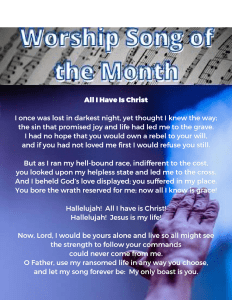
In looking together at the first two verses of this song, we recognize our helplessness without Christ, our need for his grace, and our dependence on him. In the final verse, we celebrate what it means to say, All I Have Is Christ.
The person who has put her trust in Jesus will desire to put Jesus first (“yours alone”). She will want to live a life that is above reproach (“live so all might see”). But this life of obedience to Christ is not for her moral betterment. It is not for a feeling of personal satisfaction or self-righteousness. It is not to receive praise from others, or even acceptance from God. The Christ-follower knows that only in the power of the Holy Spirit can she obey in a way that is pleasing to God (“the strength to follow your commands could never come from me”), and the goal is God’s recognition, not her own (“my only boast is you”).
Jordan Kauflin shared with me that Philippians 3:7-12 was a major inspiration for “All I Have Is Christ”:
But whatever were gains to me I now consider loss for the sake of Christ. What is more, I consider everything a loss because of the surpassing worth of knowing Christ Jesus my Lord, for whose sake I have lost all things. I consider them garbage, that I may gain Christ and be found in him, not having a righteousness of my own that comes from the law, but that which is through faith in Christ—the righteousness that comes from God on the basis of faith.
I want to know Christ—yes, to know the power of his resurrection and participation in his sufferings, becoming like him in his death, and so, somehow, attaining to the resurrection from the dead. Not that I have already obtained all this, or have already arrived at my goal, but I press on to take hold of that for which Christ Jesus took hold of me.
As we put our trust in Christ each day, we see that we are lost without him. We thank him for his initiative in saving us. We pray with reliance on his power and provision. And we desire to gain Christ and be found in him.
When I started this blog, I wanted to explore what it means to worship God. I wrote the following as my emphasis: God is both the means and the meaning, the Object and the Source. I think the final verse of “All I have is Christ” captures the essence of worship well. I am able to worship—both in “my ransomed life” and in “my song”—because of Jesus. And my worship—in life and in song—is for his glory.
For Reflection: Read Romans 11:33-12:2. Tell God that you desire him to be both the Object and Source of worship in your life. Praise him for his love and power. Ask him to show you ways to serve him. And thank him for the opportunities you have to be used by him.
Last month, in our church’s weekly email, I published an excerpt from Hymns for a Kid’s Heart by Bobbie Wolgemuth and Joni Eareckson Tada, as a special “Kids’ Edition” of our Worship Song of the Month. This is a lovely book which I highly recommend, full of the stories behind great hymns with devotional thoughts for kids. But, as far as I know, there is no source for children’s devotionals (I could be wrong; please let me know!) about songs that have been written in recent years. So, this month, I wrote my own thoughts for kids about the song All I Have Is Christ. I hope children — and all who are young at heart — enjoy.
Have you ever been told, “God isn’t a vending machine! Don’t come to God with a list of stuff you want and expect him to give them to you — like a vending machine shooting out soda and snacks!”
Do you think that’s true? If we shouldn’t pray a list of things we need or want, how should we pray?
When Jordan Kauflin started to write our Worship Song of the Month, All I Have Is Christ, he wanted to make the chorus complicated and wordy. But his dad encouraged him to keep it simple. Finally, he ended up with the simple prayer: “Hallelujah, all I have is Christ! Hallelujah, Jesus is my life!”
This simple prayer reminds us that, of all the things we need or want, Jesus is the most important. It also tells us that we can in fact come to Jesus with our list of needs and wants because we should rely on Jesus for everything. It also seems to say that, even if God doesn’t answer our prayers in a way we see or a way we like — even if we have nothing else! — Jesus is enough.
It might be a good idea to start your prayers by thanking God for saving you and loving you, the way Jordan Kauflin starts his song. Maybe you could end your prayers by asking God to help you love and serve him better, like Jordan ends his song. But in between, go ahead and tell God whatever’s on your mind — even if it’s a list of stuff you really want.
In the Bible verses we studied last week in church — Matthew 18:1-5 and 19:13-15 — we see that Jesus loves children. He loves to welcome you. He loves to bless you. When you pray, Jesus might not “shoot out” the answers you’re hoping for. But you can know that he loves you, and he loves to hear from you.





 carrie blythe davies